Archives for July 2008
Home Painting Tips From The Pros

It’s amazing how much easier it is to do anything when you have the right information.
I did some painting around my place last week, and luckily a friend of mine owns a painting company. And even though I’ve done a little painting here and there before, a little supervisory consultation with him made the job a lot easier.
So if you’re thinking of painting your house, these pro tips will come in handy …
1. Surface Preparation. First, wash your walls with TSP (Trisodium Phosphate). This is what most painters use but it’s also rather harsh. A good alternative is to use dish detergent and warm water. Just make sure you rinse the detergent residue off with a second washing of fresh water. If you’re painting a surface with a semi-gloss finish, then give it a light sanding.

2. Other Preparation. The goal is to get the job done as quickly and easily as possible. So you want to keep any masking with tape to a minimum. Remove the covers for light switches and electrical outlets and cut as much as you can with a brush when it comes to fixtures. You also want to clear the room out completely; it’s a real hassle (trust me on this) trying to work around furniture, etc you’ve piled up in the center of the room.
3. Get Good Paint. Not all paint is created equal. The main difference is pigment content. Quality paints contain more pigment and although you’re going to pay about 50% more for a good can of paint, the price is well worth it. You’ll get full coverage in 2 coats, whereas your average house paint will require 3 or even 4 coats.
4. Brushs. A thick 4 inch brush is best for cutting your trim. A lot of people might think that’s too big but there are a number of reasons to go bigger … you can actually cut a more even line with a big brush. You’ll also create a wider cut line which will make rolling a breeze afterwards. And of course, bigger brushs hold more paint which will speed up the job considerably. Make sure your brushes are made for acrylic latex (assuming) and not oil.
5. Rollers. A 10mm roller for walls is pretty standard. For painting a popcorn ceiling or rougher surface, go with a 15mm roller. And like brushes, rollers are made for either oil or latex so check the label. Another handy tool is an extendable roller pole. These are good for reaching high but also for leverage; you can apply more pressure without the exertion.
6. Other Tools. Always get tray liners for your trays and go with a deep tray; more paint, less going back and forth. A damp cloth is another good thing to keep on hand for cleaning up those drips and mistakes on the fly while the paint is still wet. Drop sheets are another essential. You can use poly sheeting which is cheap or get some actual painting drop sheets which are quite a bit easier to work with because they don’t slide around and they absorb any paint that spills on them.
7. Quick Cleanup. Let’s assume this is going to be a multi-day job. You don’t have to wash all your brushes and rollers at the end of each day. Just fill the tray up with paint and leave your brushes and rollers in the tray. Wrap the whole thing up in a garbage bag and it’ll be fine and ready to roll the next day. This is a massive time saver at the end of each day.
So there you go. These tips will help you save time and make your next painting job go a little smoother.
Del.icio.us Digg it! Reddit Yahoo Comments
Be Wary of Strategic Partnerships. Be Very, Very Wary

Building strategic partnerships is a very important part of building a strong and enduring business. But these waters are also filled with sharks, and you have to be very careful about who you get involved with. Of course, sometimes you don’t have a choice.
Case in point … last year, my neighbor had a massive problem with a partnership deal that almost ruined his business. All because he failed to isolate the deal process.
And when it comes to playing with billion dollar companies; the market leaders … the rules they play by are pretty simple. Sooner or later, they will own you or kill you. That’s their goal plain and simple, and I saw a lot of that when I was in the water bottling industry.
So let’s look at a really big deal that’s unfolding right now …
The Microsoft-Yahoo Chess Game
When Microsoft first made a bid to buy Yahoo, there was something nagging at me that I just couldn’t put my finger on. As more details surfaced it became abundantly clear; Microsoft is playing an own-it-or-kill-it game.
Emphasis on the kill-it part.
First, Microsoft made a bid that was far above Yahoo’s share value. And they did it very publicly. That doesn’t make much sense except to get Yahoo’s shareholders salivating over a big payday. Here’s where it gets interesting …
During the negotiations, Steve Ballmer basically didn’t negotiate. He did raise his offer by $1/share, but that was verbally and not on paper. So there was no room for negotiation. And that’s just not done in business. Not at this level.
So it got me wondering, ‘does Microsoft really want Yahoo’? The answer to that question came today.
If you’ve been following the saga you know that corporate raider Carl Icahn has bought up some shares and threatened to oust Yahoo’s board to try and force a sale to Microsoft. And if Icahn gets his board nominated, one thing is clear: Icahn can not run Yahoo as well as Jerry Yang can. Period. So a sale has to happen or the company will whither and die.
And today, Microsoft announced that it will re-enter negotiations if … IF … Icahn’s board is elected. And if that happens, it puts Microsoft in the driver’s seat to either pick the company up cheap or leave it to die.
Check. And mate.
The game’s chess, not checkers.
Del.icio.us Digg it! Reddit Yahoo Comments
How to Write a Screenplay Hollywood Will Love

I love movies. Always have. And every great movie, whether it’s a big Hollywood production or an indie cult classic starts with a great screenplay. The script is what attracts talent and investment, inspires genius, and ultimately just tells a great story worth watching.
And there’s a formula to storytelling that makes great movies great. A formula that never fails to rise to the challenge because it educates and entertains by grasping at the very roots of the human condition.
That formula is classical mythological story structure. And it’s allowed stories like Homer’s Odyssey to persevere for literally thousands of years. And you can play with the formula quite a bit. After all, it’s just a framework.
But there are some key ingredients you have to have to make a great screenplay. No matter what the genre, you’ll find that the best movies have these things. And the worst, don’t.
The Key Ingredients in Great Screenwriting
1. The Extraordinary Hero
Typically, you can either put an ordinary character into extraordinary circumstances or vice-versa. But there has to be something compelling here. Something interesting, new, different. There’s a reason your hero is the “chosen one”.
Your hero has to stand out. They have to have some special quality, trait, or skill that will be a great asset in the quest ahead. And your audience has to recognize it. If they don’t get it, if they don’t understand it, all is lost.
Your hero can be, for the most part, very ordinary. But there’s a glimmer there. A spark. Something extraordinary.
2. You Need an Anima
Usually, your anima (or animus) is a love interest, but not always. Your anima is the second half of your hero. She or he is a partner, a mentor, a conscience, and most importantly, a reason to move forward.
It’s the anima that enables your hero to grow and become better by helping him see something inside himself he didn’t know was there. The relationship between the hero and anima is the heart of the human experience.
3. The First Twist into the Second Quest
Of course there’s some kind of quest or mission or goal. It’s what the movie is about.
But there has to be two quests. This is a critical part of storytelling that many screenwriters leave out. You know those movies that seem to be over before they even get going … they have no second quest.
The transition from the first quest to the second is the first big twist in the movie. Your hero needs to realize that the first quest was a false one. Everything he thought was wrong. He was on the wrong path. Discovering and embarking on the second quest is where your hero grows.
It’s the point where your hero becomes worthy and can see the truth.
And the transition should be a twist in the plot that you can’t see coming. Some secret is learned. The veil is pulled back. We become enlightened. This is where the audience finds renewed life, and they start cheering “alright, here we go!”
4. The Outcome and Final Twist
The outcome is where your hero triumphs during the big climax and then rides off into the sunset. But just as important is the final twist.
Most horror movies are really weak in the final twist department. They usually just throw in a shot showing us the monster is still alive. What you really want to do is build the final twist into the story and make it part of the final climax. That’s what makes the final twist all powerful.
Mythological Story Structure
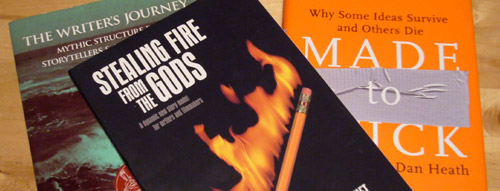
You can learn more about screenwriting and storytelling from great books such as The Writer’s Journey, Stealing Fire from the Gods, and Made to Stick.
Most people know there needs to be some kind of quest or journey and that a twist at the end is good. But there are two quests in a great story, and two major plot twists. Watch your favorite movies and find them.
Cut.
That’s a wrap.
Del.icio.us Digg it! Reddit Yahoo Comments
4 Ways to Invest in a Bear Market

Thanks to the rising price of oil and the mortgage meltdown the stock market has been what the British would call “dodgy”. There’s a lack of confidence in the ability for companies to perform and earn, and that’s driving the markets down.
But it’s not all bad news. Bear markets can bring good investing opportunities and there are numerous strategies you can employ to minimize the erosion of your portfolio and even make some money …
1. Don’t invest. A lot of investment funds are holding a larger than normal cash position right now. This is simple cash preservation and the idea is to wait out the bear; when the markets are going up, it’s because stocks in general are going up, and your chances of picking the winners are much better.
2. Go short. Shorting a stock is betting the stock will go down. You can place your bet by buying put options which is the option to sell a stock at a price in the future that you think will be higher than it will cost to buy. You can aso write call options. By writing a call, you’re giving someone else an opportunity to buy your stocks at a specific price and if the stock goes lower, the option is useless and you keep the premium (the price of the option) when it expires.
3. Finding the winners. There’s always smart money somewhere. After the dot com crash, massive amounts of capital went into property (and fueled that bubble). You want to look for those opportunities rather than focusing on the negatives; oil has been on the rise. And with it, alternative energy plays like solar have held fairly strong. Look for companies that are solving the current problems.
4. Go bargain hunting. This is probably one of the best strategies you can employ in a bear market. After all, it’s all about buying low and selling high. Companies that are holding strong against the bear or companies with low price/earnings ratios that are primed to bounce back can usually be bought at a decent discount. Also, stocks that are down while the company is still earning well and paying a good dividend can be a great investment.
There are risks to all these strategies, just as there are risks in a bull market. But using bear market strategies in a bear market is one of the keys to investing success.
And that’s no bull.
Del.icio.us Digg it! Reddit Yahoo Comments
Marketing: How Men Think Vs. How Women Think
Mark Gungor is a very good lecturer and very funny. In this video he illustrates the difference between how men think vs. how women think.
It’s really important to think about gender when you’re building a marketing campaign. Most products and services have a very specific demographic that’s either male or female. And your marketing has to appeal to the gender you’re selling to.
For example, pink and fluffy power tools … probably not a big seller.
Mark makes some important points that every marketer should take note of. When you’re marketing to men, keep it simple. Very simple. Show them how your product fixes a problem. When you’re marketing to women, build a connection; connect your product to other things in their lives. Lots of other things.
Very funny and entertaining. And insightful.