Subscribe ( RSS or )


Archives for May 2008

Phi, the Golden Ratio, and Predicting Stock Prices with Quantum Physics

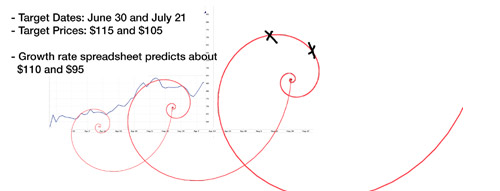
Phi Stock Prediction

When it comes to picking stocks, or picking a winner in anything, everybody’s got a system. A magic calculation that can tell the future.

Well, here’s mine …

Above, you can see a historical stock graph and 3 spiral swirls. But not just any kind of spirals … golden spirals. The golden spiral is based on the golden ratio. Otherwise known as Phi.

Phi is a mathematical pattern that we see everywhere in nature, from the shape of seashells to the very structure of our galaxy. It’s everywhere. The Golden ratio which is 1 to 1.618 is often viewed as the measure of perfection. It’s amazingly aesthetically pleasing to the eye and it’s used in graphic design a lot (called the rule of thirds).

Phi is so ingrained into everything around us that many scientists believe it holds the key to unlocking the greatest prize that physics has to offer; the grand unified theory. I tend to agree.


What Stock is This?

The stock is one of my favorites; Visa. In my graph, the first two spirals track actual rises in the stock. The third spiral predicts the next rise and fall. I also keep a spreadsheet that tracks the weekly compound growth of both Visa and Mastercard and I’ve put the Visa numbers in the graph for additional reference.

Are You Serious?

[Dramatic pause] … Hell no.

First, let me say there are a number of REAL technical indicators including historical performance, investor sentiment, and corporate fundamentals that make these predicted numbers very possible.

But I’d never make a trade decision based on my pretty little spirals. Or anyone else’s. Here’s why …

There’s a fundamental PROBLEM with any system that tries to predict the future. And it’s called the Heisenberg Principle. Which basically states that if you make a prediction, and then act on that information, your actions will have an impact that changes the future. Thus, whatever you predicted won’t happen.

I’m talking about this because I see a lot of advertisements for amazing stock trading “systems” out there. Don’t get duped.

I’m sure some of them have some success here and there. But according to the laws of physics, the more people that use a successful “beat the market” system, the less chance it has of success. The more people that game a future prediction, the more impact there is that will void that prediction.

Of course, there’s always the theory of self-fulfilling phrophecy.

Now there’s a system.

Del.icio.us Digg it! Reddit Yahoo Comments (4)

How to Find Great Stocks to Invest In

Searching for Opportunities

The mechanics of successful investing is pretty simple. Buy low and sell high. The less simple part has to do with what to buy and when to buy it. In other words, selection and timing.

Stock selection and timing are really closely related. The key is recognizing both current value and potential value. If the current value is less than the potential future value, you’ve got a winner. And of course if the opposite is true you could still have a winner by shorting the stock (betting it will go down).

Finding Stock Opportunities

There are literally thousands upon thousands of stocks out there. So first, you need to find them, and find out a little about them …

1. Yahoo Finance. This is one of my favorite places to do stock research. It’s full of big breaking news on companies and general economic trends. Their stock quotes are 20 minutes delayed but they give you company profiles, key statistics, info on competitor companies, links to news and blog commentaries and quotes on options pricing. Yahoo Finance is a great place to start.

2. Online business news. Big media players like The Wall Street Journal and Forbes are great places to find out who’s being talked about and what’s being said. You can also check out Investor’s Business Daily, The Street, and The Motley Fool. I don’t subscribe to any of these sites because, to be honest, I don’t want to be sold on some amazing “golden opportunity”. That’s a good way to lose money. I want the public news. The big chatter. I want the hook, not the line and the sinker.

3. The boob tube. It’s also good to tune into the tube and watch the business reports on BNN (Canadian Business News), CNN, and MSNBC.

Determining Value and Potential

There are companies that lose money but their stocks perform very well. At least for a while. At the same time, there are companies with solid business models that nobody cares about. What’s the deal?

A company that actually produces a profit is going to offer you less risk. Especially in the long run. Plain and simple. But regardless of that, a stock’s rise is heavily based on confidence or market sentiment.

If a lot of people believe the company has great potential, up goes the stock. It’s demand for the stock and belief that it will continue to go up that pushes up the price. At the end of the day, nothing else matters nearly as much as confidence.

This is why I don’t like super-secret “tips”. I want a stock that everybody knows about. That everybody is talking about. A stock that everybody is buying which drives the price up.

If enough people believe, it will go up.

And if those beliefs are based on sound fundamentals, it’ll keep going up. If not, it’ll go down, and probably a lot quicker than it went up.

Del.icio.us Digg it! Reddit Yahoo Comments (4)

The Next Big Investment Wave

Surfing the Big Waves

If you park your money in the same place for 20 years, you can do well. But a lot of times you’ll just keep up with inflation. And sometimes, the only gains you make come from steadily pouring money into your parking spot over many years; it’s just a savings plan. Not an investment plan.

Great returns come from catching the waves. Good waves can last anywhere from 2 to 5 years. You hop on, ride high, and then hop off and look for the next one.

The dot com bubble was a nice wave. And over the last few years property has been a good wave. The real question though, is … where’s the next big wave?

Wave Spotting

The answer has 2 parts. First, the sectors or industries should be experiencing strong growth. And second, where individual companies are concerned, they should have strong growth potential.

And by strong growth potential I’m not asking myself “are they cool” or “are they in the hot industry of the moment”. The question I’m asking is “can they sell it”?

Big Wave Candidates

Here’s a list of strong sectors to keep your eye on and maybe get involved with. In each of them there are a whole host of companies.

I won’t list specific companies because you should do your own research. And no matter how hot an industry is, some companies will bring stellar performance and others will completely bomb.

1. Commodities

Have to mention it, just because the cost of everything (energy, grain, metals, etc) has been on the inflationary rise. Commodities are the raw materials for everything else. When they go up, the cost of everything goes up. And that’s the problem with commodities that I don’t like.

Not only do rising commodity prices have the power to hurt every other investment opportunity out there (costs rising faster than revenues), but they have the power to hurt their own earning potential too.

2. Alternative Energy

One good side-effect to the high cost of commodities (oil) is the strength in alternative energy sources. Solar is very strong (I resisted the temptation to say it’s hot). Wind is strong. Biodiesel.

It’s also worth looking at the technologies that make these energy alternatives easier, more efficient, and cheaper to produce.

3. Food Production

Companies that produce phosphates and potash (fertilizers) that aid in agricultural growth and food production have been very strong. This is, with regards to chemical pollution, a controversial industry. But given the alternative (trying to feed the world with lower crop yields), it’s got nowhere to go but up.

4. Financial Companies

Banks and investment corporations have been taking a bath thanks to their risky plays in the subprime mortgage market. And they’re still wet. But they’ve got 2 things going for them.

One, they’re down and that translates into “they’re cheap”. Two, finance is the cornerstone of every other business and investment vehicle. They don’t just make money, they are money. In the second half of 2008, we’ll really start to see who the comeback kids in the financial sector are.

So those are a few hot sectors. There are others, and of these I’m more bullish on alternative energy and finance because I can wrap my head around them easier than the others. Which is an important point in itself …

If you don’t understand how they make money, gravitate towards something you have a better understanding of. It’ll help you sort the winners from the losers a lot easier.

Post your wave faves for 08 and beyond in the comments.

Del.icio.us Digg it! Reddit Yahoo Comments

Business is Good, Business is Bad … When to Advertise and How

Old Restaurant Sign

The “when” is easy to answer. Always. This isn’t as obvious as it sounds because in practice, most businesses start marketing and advertising when they start up and then one single thing always happens that makes them stop …

Change.

It can be change for the better, or for the worse. But that change usually becomes the new focus. It’s either “Oh wow, we have all these orders to fill” or it’s “Oh no, things aren’t going as planned. We have to make some cuts”.

To keep a good thing rolling forward or to turn around a bad situation, you have to keep some focus on your marketing and advertising and translate all of it into sales. Here’s how to approach your advertising based on your situation …

1. Build your brand. Things are going great. You’ve got more business than you can handle so there’s no use wasting money on marketing right? Wrong. This is the time to build your brand.

When you build your brand you get customers coming to you. They’re coming to you because they know you and trust your brand. And when people are coming to you; when they want what you have, it’s a lot easier to charge more and increase your margins.

2. Refocus your pitch. It’s easy to throw marketing dollars out into the world and not generate any sales. If you need more sales and your marketing isn’t doing the trick it’s a simple matter of “evolve or die”.

Look at who you’re advertising to. Where you’re advertising. How far removed is your advertising … how long does it take and how many steps are there between your pitching point and ringing in the sale? Is your pitch timely? Relevant? Does it grab attention? Does it make an offer people can’t refuse? Keep changing your pitch until it works.

3. Scale back everything else. When business is down, one of the first things that often gets cut is the marketing budget. Every department gets a haircut. But if your advertising is bringing in whatever sales a down market will allow you, then it makes more sense to keep it up and trim everywhere else.

Look at cutting all your expenses outside of sales. Renegotiate your purchasing costs. Scale back your production and your production staff - or see who you can repurpose and move into sales. If you can cut back your operations to a level that your sales in the current market can pay for, you can ride out the downturn or buy some time to restrategize your whole business. But if you cut back on advertising and marketing, the result is even lower sales.

Your advertising, your marketing, and your salespeople have one job. To pay for everything. In good times and bad.

And that never changes.

Del.icio.us Digg it! Reddit Yahoo Comments

First Mover Advantage is NOT Critical to Your Success

Racing Turtle

First mover advantage; being the first one in a market or to develop a new technology can be a huge advantage. At the same time, doing all that hard work also lays the foundation for someone else to step in and do it better.

So if you’re a first mover, great. If not, no sweat. All you have to do is find an edge that gets everybody talking about the new kid on the block.

Let’s look at some “second-movers” and see how they did so well …

1. Microsoft

First there was Apple, then along came Billy G and some new ideas. Big ideas. Where Apple has always developed their operating system and assembled the hardware, Microsoft opened the floodgates to thousands of other compaines by licensing their OS and letting others build and assemble the hardware.

If you can create opportunities for other companies and entrepreneurs to prosper with your product, you can take the lead.

2. Pepsi

Coca-Cola was a strong and growing company when Pepsi came along. Today, by some metrics Coke is still in the lead and by other metrics it’s Pepsi. But Pepsi came along after Coca-Cola was well established.

I don’t know if I’d call a $100 billion company an underdog, but being the “alternative” and having the drive to do better will take you a long way.

3. Google

Before Google, there was Yahoo. And even before Yahoo there was Infoseek. A strong combination of stick-to-your-brain branding and innovative technology will get people to use your products and services.

If you can be memorable and fun, and if you can make a task faster and easier, you’ll do well.

4. Research in Motion

The Blackberry (or crackberry if you prefer) wasn’t the first cell phone. They’re insane success comes from doing a little bit of everything …

If you can develop a strong brand, create an easier way to do something, and create opportunities in the marketplace (RIM builds their devices and the mobile networking technology they and other devices use), you’re going to do very, very well.

Being first helps. But it’s not critical to creating success. Most businesses don’t create anything new, they just take something that already exists; something that already has a proven market, and they make it better.

So, you can be first. Or you can be better than first.

Del.icio.us Digg it! Reddit Yahoo Comments (2)

Possession is 9/10ths of the Law … Getting Paid 301

Handcuffed to Briefcase

In Getting Paid 101 I talked about how to be pre-emptive and simply run your business in a way that helps (a lot) to make sure you get paid by delinquent clients. In Getting Paid 201 I talked about skip-tracing; or tracking down those fly-by-nighters that skip out on paying you.

Well, sometimes, you don’t get paid but you still have to do business with a company that owes you money.

It might be because they’re a significant portion of your revenue. And if they owe you a significant amount of money and you’re a significant supplier of theirs, it’s usually in your best interest to help them keep the ball rolling, generating revenue … so they can pay you!

This can be a very maddening situation so the first thing to do is get rid of all that emotion. Take a few minutes to yourself and cuss them out.

Good? Alright … moving forward, you have to play it smart and use your advantages. Here they are:

1. Hold Their Assets

“Possession is 9/10ths of the law” is an old decree that stems from Old English Law. Basically it means that if it’s in my hands, it’s up to you to prove it’s yours. In this case, if they owe you money, why would you give them their stuff.

So if you store goods or materials of theirs, or if you carry an inventory of items that are labeled with their brand or whatever, hang on to it. It has worth, so use it to bargain with.

Most of the time you can just tell them you’re hanging on to this collateral until they pay you. If you have to bring in the lawyers (and some industries have specific rules for this) you can put a lien on their property. What happens then is you hold on to it until they pay you. If they don’t pay you within a certain timeframe, you can sell their property at public auction.

Regardless, make sure you talk to your lawyer about your options when it comes to holding their assets.

2. Put Them on C.O.D.

They already owe you money. And you don’t want to get in any deeper than you already are. But you need to keep the business rolling.

This is where COD or “cash on delivery” comes in. The key to putting a customer on COD is to stick with it. No matter what. The longer it goes on, the more they’ll need something “right away” without you getting cash in hand first.

No payment, no delivery. Period. Call them up and tell them the order is on hold until you receive payment. If they need the order and they have the money, you’ll get a wire transfer or someone coming by with a check within a couple hours.

COD also offers a good opportunity to add a premium to your price. You can apply this premium to their outstanding balance (sort of a payment plan), but I generally just call it a price increase.

3. Get a Secured Promissory Note

When a business fails there’s a certain order as to who gets paid first. It goes like this:

  1. The government (taxes, fees, etc)
  2. Financial institutions (loans and lines of credit)
  3. Secured creditors
  4. Unsecured creditors

If the amount they owe you is significant, then really push to get a secured promissory note. A secured note is registered with a government body (talk to your lawyer) and it basically says they promise to pay you and they’re backing that promise up with collateral assets they own.

As a secured creditor, you’re one step up from the bottom of the totem pole and you’ll get paid before any unsecured creditors will.

So there you go. Hopefully you don’t run into too many situations where you don’t get paid. But it will happen. That’s business.

Fortunately, you’ve got a few more tools in your bag now to deal with it.

Del.icio.us Digg it! Reddit Yahoo Comments

You Can Dig for Gold, Sell Shovels, or Better Yet … Build the Railway to California

Railway

In reference to the great California gold rush of the 1800s it’s really popular to say “Don’t dig for gold, sell shovels”. The logic is sound because rather than investing in high-risk speculation, you can take a much more certain road and sell the tools that these high-risk, high-reward speculators need.

But there’s a limit to how many shovels you can sell. And there’s something bigger that both the gold diggers and the shovel sellers need. And that’s the railway to get to California and back.

When you build a “railway”, you’re building a platform, a gateway. The backbone of it all. You’re building a conduit through which all things must pass.

Examples of Business Railways

  1. Industry Standard Formats. Format wars are intense and Sony recently won the hi-def war when Toshiba bowed out. Sony now owns the hi-def railway and there’s a whole host of businesses that have to pass over it; companies that make DVDs, players, recorders, authoring software, films, and video games … they all ride the Blu-ray train now.
  2. Platforms. The MS Windows and Mac OSX operating systems are both platforms. Railways. Every piece of software needs an operating system to run it. And the beauty of creating a platform is you can make both the railway and the trains. In this case, that’s the OS and the software.
  3. Technologies. The Legaignoux brothers developed a simple yet amazing kite design for kiteboarding using inflatable struts. Every other kite manufacturer licenses the right to use their patented design. And those license agreements also set the price ranges at which each company can sell their kites. Can you say “All our competition are belong to us”.

There are lots of examples of business railways out there. And you don’t need to be a billion dollar company to do it. Microsoft started somewhere. So did the Legaignoux brothers. Any business can build a railway. You just need to recognize what people need, be innovative, and set the standards in your niche, local market, or industry.

Start small. And think big.

When you build a format, a platform, or an innovative technology, you’re building a railway. And everyone; gold diggers and shovel sellers included, needs to get to California somehow.

Can I see your ticket please.

Del.icio.us Digg it! Reddit Yahoo Comments (1)

Conscious Productivity: Seeing the Forest, Not Just the Trees

Tree Forest

Tunnel vision is probably one of the best ways to create unproductive time. At a certain point it’s not focused concentration anymore. It’s just ignoring everything else and a lot of better opportunities. And it’s also limiting the angles and creativity you can apply to the current task.

Now surround yourself with a whole flock of tasks like that. It’s like being in the middle of a forest but you can’t see the forest or anything beyond it. No matter what direction you look in, all you see is trees.

You’re trapped.

Each one of those trees wants your attention. You have to get through one tree only to be greeted by another. And you have to clearcut valuable trees out of the way just to get some help in there.

Taking Strategy Breaks

Without a strategic plan; without seeing the whole forest from 20,000 ft up, it’s really easy to stay lost in the trees or to hack away without really getting anywhere.

This is where taking strategy breaks throughout the day comes in. A lot of people talk about how task-switching is a big time killer. And it can be. If you’re checking your email constantly or putting out little fires or losing your rhythm, you can lose a tremendous amount of time.

But I’m not talking about task switching. That’s just going from one tree to the next. Strategy breaks are about leaving the forest. So you can look at it from a different perspective.

Walk away and get unstuck. See everything. See all the trees and notice the ones that really stand out. The gems. See the ones that don’t matter. See the ones that will one day grow tall and strong.

That’s strategy.

The Trees Aren’t Always Green, But the Forest is

It’s those ideas you get in the shower that are gold. Those flashes of clarity when you’re sitting there mindlessly strumming a guitar or kicking back to cool down after a hard workout.

I’ve generated more revenue just staring stupidly at the mountains than I ever have hammering away on a mountain of tasks.

Trees are easy to see.

It’s seeing the forest that takes vision.

Del.icio.us Digg it! Reddit Yahoo Comments (2)

Copyright 2007-2008 Zoomstart.com - All Rights Reserved · · Home · About · Legal/Privacy · Contact · Advertise