Marketing
Marketing: How Men Think Vs. How Women Think
Mark Gungor is a very good lecturer and very funny. In this video he illustrates the difference between how men think vs. how women think.
It’s really important to think about gender when you’re building a marketing campaign. Most products and services have a very specific demographic that’s either male or female. And your marketing has to appeal to the gender you’re selling to.
For example, pink and fluffy power tools … probably not a big seller.
Mark makes some important points that every marketer should take note of. When you’re marketing to men, keep it simple. Very simple. Show them how your product fixes a problem. When you’re marketing to women, build a connection; connect your product to other things in their lives. Lots of other things.
Very funny and entertaining. And insightful.
Del.icio.us Digg it! Reddit Yahoo Comments (1)
J W Waterhouse and the Art of Marketing

Or maybe I should say the marketing of art …
I’ve been doing a lot of drawing lately - gearing up for an amateur painting contest with some friends. And this is all on the lo-fi, and by that I mean on canvas, not photoshop.
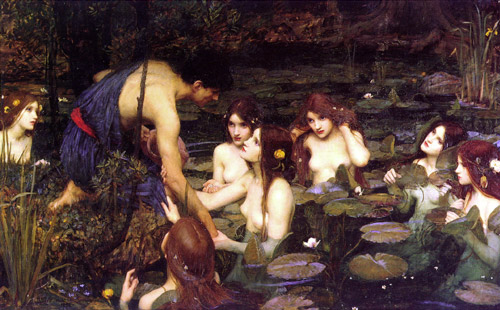
Anyway, I’ve also been studying some of history’s great masters to get some ideas on style and technique and I came across J W Waterhouse’s Hylas and the Nymphs. And my first thought was … ‘Man, that’s good marketing’!
So let’s take a look at this great classic work of art (pictured above) and see what it can teach us about marketing …
- Sex Sells. Like it or not, it’s true. Personally I think it’s more correct to say “sexy” sells. Regardless, you can put a pretty smile on a bottle of rat poison and rats or no rats, sell truckloads of the stuff. Nothing is more imperative than the biological imperative.
- Find the Ideal and Repeat it. Idealism was an art movement that basically took the best parts of Realism and threw out the rest … look at all the nymphs … they could be twins, triplets, er … well you get the point. They’re all the same. They’re all Waterhouse’s ideal version of a beautiful woman. And repetition is what you use to promote your ideal.
- It’s All About Lifestyle. Location is a big part of this. So is portraying leisure and fun. What could be more refreshing on a hot summer day than a cool, clear freshwater swimming hole. Think about the lifestyle you want to associate with your product or service and transport your customers there with your marketing.
- The Real Story is Just Beginning. The end-note of your marketing is just the beginning of your customer getting on board. And it’s always good to leave your audience wanting more. As a marketer, it’s your job to lead people to the idea of what that “more” is, and then let them get involved and write the next chapter themselves. In the painting, you can see that Hylas is being dragged into the pond by the beautiful nymphs. And that’s where the painting ends.
But that’s not the end of the story.
Not if rule number one has anything to say about it.
Del.icio.us Digg it! Reddit Yahoo Comments
Business is Good, Business is Bad … When to Advertise and How

The “when” is easy to answer. Always. This isn’t as obvious as it sounds because in practice, most businesses start marketing and advertising when they start up and then one single thing always happens that makes them stop …
Change.
It can be change for the better, or for the worse. But that change usually becomes the new focus. It’s either “Oh wow, we have all these orders to fill” or it’s “Oh no, things aren’t going as planned. We have to make some cuts”.
To keep a good thing rolling forward or to turn around a bad situation, you have to keep some focus on your marketing and advertising and translate all of it into sales. Here’s how to approach your advertising based on your situation …
1. Build your brand. Things are going great. You’ve got more business than you can handle so there’s no use wasting money on marketing right? Wrong. This is the time to build your brand.
When you build your brand you get customers coming to you. They’re coming to you because they know you and trust your brand. And when people are coming to you; when they want what you have, it’s a lot easier to charge more and increase your margins.
2. Refocus your pitch. It’s easy to throw marketing dollars out into the world and not generate any sales. If you need more sales and your marketing isn’t doing the trick it’s a simple matter of “evolve or die”.
Look at who you’re advertising to. Where you’re advertising. How far removed is your advertising … how long does it take and how many steps are there between your pitching point and ringing in the sale? Is your pitch timely? Relevant? Does it grab attention? Does it make an offer people can’t refuse? Keep changing your pitch until it works.
3. Scale back everything else. When business is down, one of the first things that often gets cut is the marketing budget. Every department gets a haircut. But if your advertising is bringing in whatever sales a down market will allow you, then it makes more sense to keep it up and trim everywhere else.
Look at cutting all your expenses outside of sales. Renegotiate your purchasing costs. Scale back your production and your production staff - or see who you can repurpose and move into sales. If you can cut back your operations to a level that your sales in the current market can pay for, you can ride out the downturn or buy some time to restrategize your whole business. But if you cut back on advertising and marketing, the result is even lower sales.
Your advertising, your marketing, and your salespeople have one job. To pay for everything. In good times and bad.
And that never changes.
Del.icio.us Digg it! Reddit Yahoo Comments
If You Want to be The King … Do What The Kings Do

The very nature of being an entrepreneur means you’re taking a bit of a shot in the dark with your business idea. You’re blazing a new trail. Going where (hopefully) no one else has gone before.
But you can make your startup a whole lot easier by following someone else’s trail in the beginning.
You Gotta Be a Prince Before You Become King
In the end, it’s that new territory that you discover and conquer that will make you the king in your industry. But you’ve got to start somewhere, and the best place to start is to follow the current kings around and learn from them.
No matter what you’re selling; products, services, affiliate marketing … there are already people and companies out there making an absolute killing in the market. Some of them spend millions of dollars develping packaging that sells, ad copy that stops you in your tracks, and websites that convert into sales.
Take advantage of that.
You don’t want to follow just anyone around. Track the best. If you’re into real estate, pay attention to Donald Trump, not the local ReMax dude. If you’re into internet marketing, pay attention to Yahoo rather than the average A-list blogger.
Don’t simply copy them or rip them off blatantly. Dig into what they do and understand it. Test it. Learn and emulate.
It’s an education in sales psychology, language, graphic presentation. They’ve spent millions on your education. Are you gonna pass that up?
Start Rolling Before You Rock It
It’s true, you can’t become the king by following others. But your goal here is to just get the ball rolling. You’re using what’s already proven to work to get started and start generating some real success. As you go along, you’ll understand what works, what doesn’t, and why.
That’s some serious capital that you can parlay into blazing your own trail once you’ve built a solid foundation and some sustainable earnings.
And from there, the sky’s the limit.
“Only thing worse than watching a bad movie is being in one.”
~ Elvis Presley
Del.icio.us Digg it! Reddit Yahoo Comments (1)
Beggars Banquet Marketing

We’re going to travel back in time today … all the way back to 1968 and the release of the album “Beggars Banquet” by The Rolling Stones.
Why? To understand a little bit more about sales and marketing. You see, when something like a song becomes a classic, there’s a very good reason why. It’s because it strikes a chord with us. It tells a story. Imparts great knowledge.
It contains ideas that fit neatly into the collective consciousness.
Finding Success in Success
The formula goes like this: It takes a certain mindset to be successful (and The Rolling Stones have been very successful). And so, anything that comes out of a successful person’s mind has the great potential to create more success.
Knowing that, I’m going to take the first four lines of the song “Sympathy for the Devil”, and apply them to sales and marketing …
1. Please allow me to introduce myself
Okay, pretty straight forward. If you don’t network, if you don’t get out there and knock on doors, you can’t make any sales. Sitting and waiting for customers to magically appear just doesn’t work. You have to go out, introduce yourself, and create the opportunities for others to buy from you.
2. I’m a man of wealth and taste
And when you’re introducing yourself, you want to put your best foot forward. The old “pity pitch” never built a million dollar business. People want to be associated with success and they want to do business with other successful people … sort of like “birds of a feather, flock together”.
3. I’ve been around for a long, long year
When you’re marketing yourself, your products, your services; you need to have answers. Potential customers will have questions. It’s your experience, your preparation, and your creativity that’s going to get you through smoothly. Trying to make a pitch and getting bombarded with questions you can’t answer can quickly turn into a sweating session that makes you look like you just got water-boarded.
4. Stole many a man’s soul and faith
Knowing your competition and what they have to offer is essential. Because, you’re basically competing with them and everything your customer knows about them. You’re competing against another brand, another deal, pricing, extras … and your job is to find the sticking points that bring the customer closer to you, and the deal-breakers that move them further away from your competition.
So there you have it. You can find successful strategies in many instances of success. The more examples you find in the world, the more overlapping patterns you’ll find that just always seem to hold true.
And just for the record. No, I’ve never been to St. Petersberg.
Del.icio.us Digg it! Reddit Yahoo Comments
Made To Stick … 6 Ways in 6 Days to Make Your Ideas Sticky

No matter what you’re doing - communication, networking, and having the ability to “sell it” is key to success. Your ideas, discussions, speeches, ramblings, sales pitches; they all have to have an impact. They have to stick.
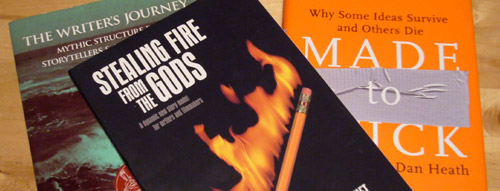
Well, Chip Heath and Dan Heath wrote the authoritive book on the subject. It’s called Made to Stick: Why Some Ideas Survive and Others Die. In the book, they map out 6 principles for making your ideas stick and it’s filled with great stories, real experiences, urban legends; the works.
So here’s a 6 day challenge for you. Take the principles from Made to Stick and concentrate on one of them each day; throughout the day. Whatever you’ve got to say, write, or convey to others, use the principles to do it and make your ideas stick …
The 6 Day Made to Stick Challenge
- Simple. An idea has to be simple if it’s going to stick. People have to be able to understand it, focus on it, and relate it to things they already know. Simple ideas are short and sweet; they get past the confusion and right to the core of what you’re saying. Sell it in a sentence.
- Unexpected. An idea with an unexpected twist is extremely powerful. It stops people in their tracks and it’s the secret behind great comedy (the unexpected punchline) and thrilling never-saw-it-coming endings in movies like The Sixth Sense. Keep everyone on their feet and give them something they’d never expect.
- Concrete. Relating your ideas to “real world” things makes them just as real. It makes them concrete. If you can take people to a place or show them an object, you can make the idea that much more real. You can also paint a mental picture that relates your idea to something visual. Or a smell, a taste. A place they’ve been or a common childhood experience that most people have gone through.
- Credible. Albert Einstein once said … well, Einstein could pretty much have said anything and it’d be credible. Because he could prove it. Prove your ideas; cite expert testimony, show the figures and statistics. And best of all, demonstrate it; if you can provide indisputable real-world proof your idea is real, it’ll stick.
- Emotional. If you can make people care about it, they’ll get it. Emotions are all about change. And if you can inspire and motivate, create a call to “right a wrong”; if you can compel people to take action to make change, your ideas will stick.
- Stories. Since the beginning of human history, stories have been our most powerful vessels for knowledge. Stories paint the whole picture; heroes, villains, triumphs and tragedies. Stories combine the simple, the unexpected, the concrete, the credible and the emotional. Turn your ideas into stories and they’ll not only stick. They just might become legendary.
Good luck with the challenge. And don’t worry, if all else fails …
There’s always duct tape.
Del.icio.us Digg it! Reddit Yahoo Comments (1)
The Power of Focusing on Results

First off, welcome to all of you who are recent Zoomstart subscribers. This post, in a roundabout way, is about you. Read on …
After starting Zoomstart last year and blogging away for about 9 months, I managed to gain about 200 subscribers. I stopped writing for a few months because of other commitments, and then about a month ago I started writing again. And in the last month my subscriber count has rocketed up to around 300.
Okay, those don’t seem like earth shattering numbers, but a 50% gain in subscribers in one month compared to the results of the entire previous year is very significant. Annualized, it’s a 600% increase year over year.
Don’t Focus on the Goal … Focus on the Result
The reason for this big increase in Zoomstarters is because I focused the blog (theme design, etc) on results rather than goals.
Err … what’s the difference?
The difference is small. It’s subtle. And it’s extremely powerful. An example goal is “I want to increase my subscribers”. But the difference that comes from focusing on results goes more like this: “I want more people to subscribe”.
Did you see it? The difference. Subtle isn’t it.
A goal gets your brain into the mode of thinking ‘Here’s what I want to do’. But a result; a beautiful, wonderful, amazing and just maybe earth shattering result gets your brain thinking in an entirely different mode. You start thinking ‘Here’s how I actually do it’.
A result is more action oriented and “where you want to go” is already built in to it. And that lets you focus on solutions to the real question which is “How do I get there”.
No matter what you’re trying to achieve, goals can steer you off course. Goals can be cliche. They can be all glitz and glam. Self indulgent. Egotistical. They can even be simply unattainable. The point is, goals have a way of selling themselves as great ideas.
But only results get results.
Del.icio.us Digg it! Reddit Yahoo Comments (1)
High Concept Marketing: Sell it in a Sentence

It’s well known in politics; if you say three things, you say nothing.
We’re all bombarded with ideas all day long. What we need, what we’re looking for, is an idea that jumps out at us. A single understanding so extraordinary that everything else around it suddenly ceases to exist.
So profound in its simplicity and still … still, it has the ability to describe an entire world to us. An idea so loud, so clear, so universally understood that it can’t be mistaken for anything else … ladies and gentlemen, I give you, “jaws on paws”.
? … Dude, you’re losing it. Okay, let me explain …
Millions of Dollars are Made Everyday with Single Sentences
In 1975, a little director made a little movie based on a book. The director’s name was Steven Spielberg and the movie was Jaws (which became the highest grossing movie ever at the time).
In 1983, another book was turned into a movie. It wasn’t an easy idea to pitch if you try to flesh out all the ideas the story involved. But it was successfully pitched, and made, and enjoyed moderate success.
The movie was Cujo; Stephen King’s rabid dog horror flick and it was sold with three simple but powerful words. Jaws on paws.
Million dollar deals are made every day and the best ones are locked in with a single sentence.
High Concept or “Single Sentence Marketing”
What are you selling. In one sentence. You’ve got 5 minutes with a play-maker. You’ve got 5 words to fit on a poster that has to capture people as they stroll by. You’ve got a flyer. A business card. All you’ve got is a freakin’ t-shirt.
And in that tiny space, and space of time, you have to fit the weight of thousands of words and images. You have to fit in an 80 minute Powerpoint presentation. A video. Pie charts, spreadsheets, an interactive workshop, an expert-panel discussion and a live action skit.
High concept marketing makes it easy. Every person on the planet has a wealth of preset understandings of the world and the things in it. All that stuff you need to say … is already in their heads.
You just need the right sentence to bring it out.
What are you selling. In one sentence.
Del.icio.us Digg it! Reddit Yahoo Comments (6)
The No-Rules Guerilla Marketing of Crackass

My buddy’s brother made an amateur film called Crackass: The Surrey Movie. Just a guy with a handycam and a group of do-anything friends. The movie’s not going to win any big awards, but along with some truly disgusting Jackass-style stunts, there is some real value to it from a documentary perspective.
So how do you sell a flick like this anyway?
Well, here’s one of the things he did. Figuring that his old highschool was a good targeted demographic, he called up the school and announced that he was going to be there at a specific time on a specific day selling his movie. Then he called up the local TV news channels and the local newspapers and told them too.
Oh, yeah … and the other thing he told all of them was this; as a publicity stunt for the event, he was gonna have a stunt guy there set himself on fire.
All the Forces Collide
So the next day the police come knocking on his door. They’ve been hearing some big concerns about his little stunt. He assures them it’s not going to happen (he never had any intention of doing it in the first place), and that’s that.
The day of the event, he shows up (off school property of course) and is greeted by the police, a couple fire trucks, and a cast of media sharks … all of which drew the attention of the kids coming out of the highschool.
He sold a couple dozen DVDs and t-shirts that day. And got some (more) media coverage.
He sold them at pubs, at parties. He even held a screening of the movie at a local pub and sold tickets to the event. Guerilla marketing works. It doesn’t require a budget. It just requires your imagination.
And the guts to do what most people won’t.