
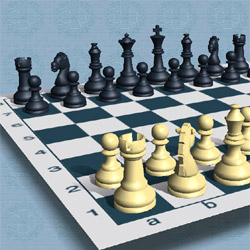
If you’re not too familiar with chess, not to worry. Read on.
Chess has a long history. It’s been around for at least a thousand years in its current form. And for good reason. It’s been teaching Kings, Queens, Emperors and other power brokers about strategy since its inception.
It’s also a game that’s full of rich symbolism. Castles, Knights, Bishops, Pawns; every piece takes us back to thoughts of ‘the days of old’. I’m going to attach some symbolism to some of the pieces to get you thinking about how to approach a problem, and then I’m going to show you some of the key strategies that chess teaches.
These are all things that are applied by successful companies today.
Attacking A Problem, Piece By Piece
The Rook. Or castle, moves straight ahead, back, or side to side. It’s a forceful piece. Think of it as military power. In business, think of it as size and strength. The Rook is a great defensive piece. It’s not fearful, and offensively it can sweep in quickly and own a section of the board. Or a slice of the market, since we’re talking about business.
The Knight. Even today, if you own horses, it’s a good sign that you have money. A thousand years ago, having a stable full of horses meant great wealth. The Knight, or horse, is financial power. The knight moves in an L-shaped pattern and can jump over other pieces. It’s most effective in the center of the board. If you can drop a load of cash into the middle of a situation, you can have a say in what happens. Of course, with Knights and cash, you need to have a sound exit strategy, or you could lose them.
The Bishop. Politics, negotiation and influence all fall under the realm of the Bishop. In business, it’s about making connections. It’s about managing a situation or sweeping in to clean it up. The Bishop travels diagonally and often seems to come across the board out of nowhere. Oops, I didn’t know you knew so-and-so.
So those are the things you can leverage to your favour; size and strength, capital, and connections. Now on to the strategies.
Business Strategies From Chess
Keep the pressure on. With every move you need to force your opponent to make a predictable defensive move. This is how you stay in control of the situation and prevent them from taking action of their own. They’re constantly reacting. Putting out fires. Unable to execute their own strategy.
Every move counts. A bad move is a wasted turn. You lose time, ground, momentum. You run the risk of losing control of the situation and finding yourself on the run. Great chess players and business people are very conservative during the opening with what they do. But once they’ve gained some ground …
Every asset counts. In grandmaster chess, if you lose a piece and fail to take one on your next turn, it can cost you the game. Business can be that competitive. You need every asset that you have to gain an edge. Once a grandmaster is two pieces up on an opponent, victory is practically assured. The momentum picks up and it snowballs from there. Use everthing you’ve got. If you’re not using it, sell it and turn it into cash that you can use.
Chess teaches you to take complex situations and heavy pressure and deal with them. It teaches you strategies that are intrinsic. The value is in their very nature, sort of the way you can always count on gravity to make an apple fall on someone’s head. It just is.
I like to play Chessmaster occasionally. The game has a great interactive tutorial section put together and hosted by several chess grandmasters. And there are dozens of preset computer players with radically different styles to play against.
And when it comes to business, remember, the game’s chess not checkers.
Shane,
This is an excellent post! I love the game of Chess, and I’ve thought about this as an analogy for business and life strategy before. Great job laying it all out.
That last line about “the game’s chess not checkers” is a great reminder. I think that a lot of businesses, especially smaller ones, deal like there playing checkers……rather than having a strategic plan and making the most of every opportunity.
Anthony,
Glad you liked it. Chess is a great challenge. I like it because it exercises both the analytical side and the creative side of your brain at the same time.
And yeah, a lot of companies bring their checkers skills to a chess game! 🙂
Great analogies. In chess you also need to think many moves ahead – same with a business!
Many moves with many different pieces! Absolutely Gregg. You also have to think offensively and defensively at the same time.
Excellent post mate. I am not a great one at chess, but I understand the game. Keep the pressure on, Every move counts, Every asset counts, yes yes thats all the kind of strategies you need to apply to make your business successful. I loved this post Shane.
Thanks Robin. I like the strategies chess teaches because they’re very natural. There is no way to go against them and win unless you get very, very lucky.
Hi Shane,
Although I’m not a Chess player I appreciate the way you explained the whole process of playing Chess. Thanks so much for your times in doing this.
Perfect article. I have been playing amateur chess for a while now and one thing I noted is that most people who beat me in chess couldn’t apply their chess skills in real life. Would be grateful to know how the transition of skills occurs?
I mean, you have this player with really good chess skills but when it comes to real life–he makes bad choices. What should one do in order to make the chess transferable to life in an auto-invoked, habitual way? Can it be done and if so what criteria/training/situations/immersions must one undertake?
Thanks for sharing.
James
Hey James,
That’s an interesting question.
When you look at the business strategies I outlined, those are the kinds of concepts that you can learn from chess and apply in real life. But they’re guiding strategies, not step-by-step plans.
The real life situations where you can apply these kinds of strategies are so diverse, there’s no easy way to “train” these skills. But I think one could start by studying situations post-mortem … situations with favorable outcomes, and those without. And match up the strategies that worked versus those that didn’t.
And then, over time you start to build experience, instinct and a practical use for your chess strategy arsenal.
Very nice post. I have found that Chess is a lot like Life in many areas, and very much so in relation to Business. To see my appreciation and thoughts on their shared fundamental relationship expanded upon by another person so efficiently is quite refreshing to say the least. This post has tickled the philosopher in me. I feel the sudden urge to ponder the subject in greater depth; perhaps over a game of Chess…
I think chess really provides the exercises to strengthen your thoughts to empower decision making skills.